

2027 Ford Bronco vs Bronco Sport
Lynch Ford of Mukwonago
The difference between the Ford Bronco and the Ford Bronco Sport is structural. The full-size Ford Bronco is a body-on-frame SUV engineered for severe off-road driving, with a two-speed transfer case and true low-range gearing, high ground clearance, and removable doors and roof panels. The Ford Bronco Sport is a compact unibody crossover with fixed body panels and a standard single-speed 4x4 system, built to balance light trail capability with car-like highway efficiency and daily drivability.
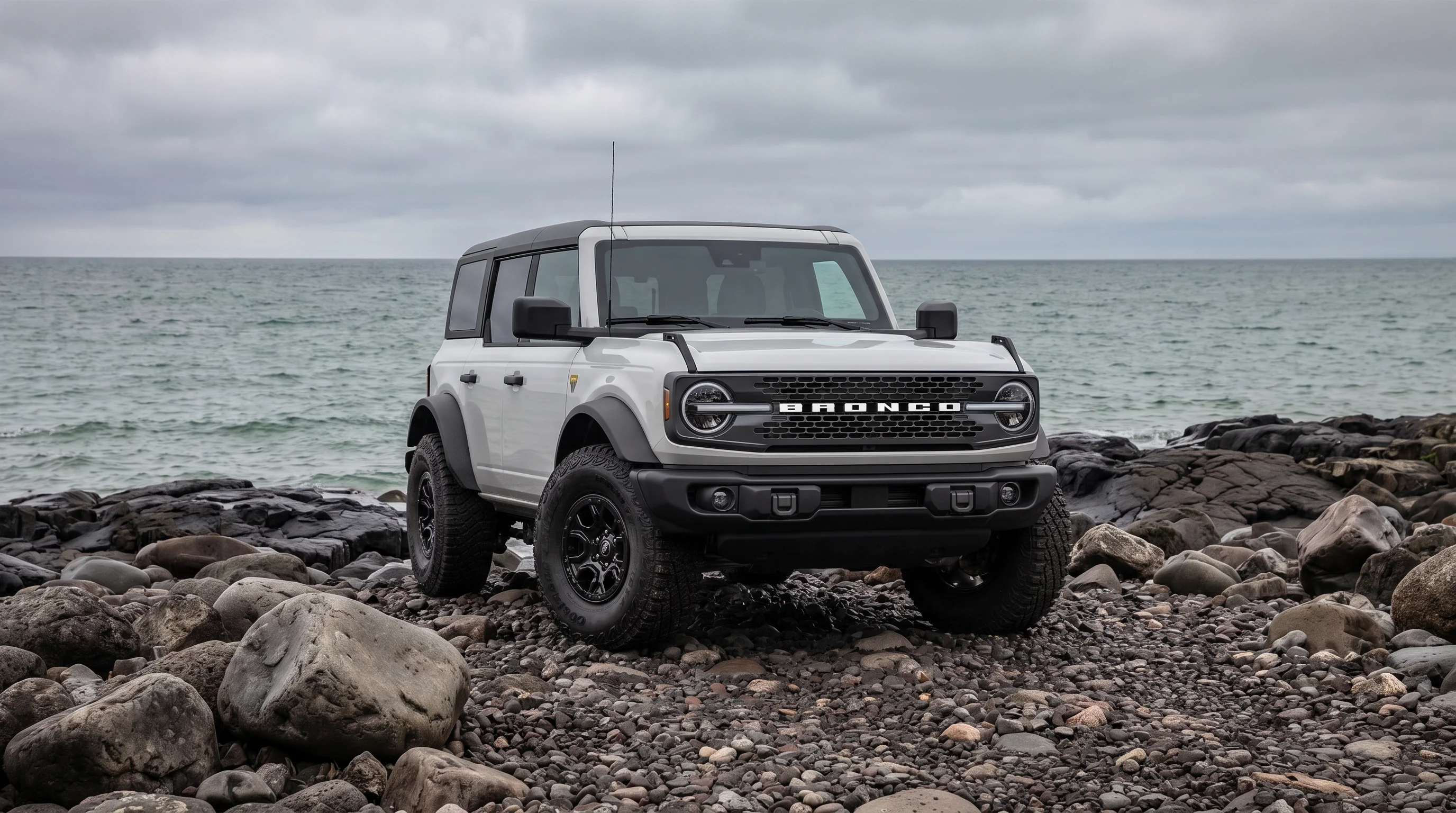
Both SUVs wear the Bronco name and share Ford's G.O.A.T. Modes terrain management system, but they are built on fundamentally different platforms for fundamentally different kinds of driving. The full-size Bronco is engineered around a two-speed transfer case, a solid rear axle and removable body panels, while the Bronco Sport is engineered around a unibody structure, a standard single-speed 4x4 system and stronger fuel economy for daily commuting.
Platform Architecture: Body-on-Frame vs Unibody
| Architecture | Ford Bronco | Ford Bronco Sport |
|---|---|---|
| Construction | Body-on-frame | Unibody crossover |
| Doors & Roof | Removable doors and roof panels | Fixed body panels |
| 4x4 System | Two-speed transfer case, low range | Standard 4x4, single-speed; Advanced 4x4 on Badlands |
| Engine Layout | Longitudinal | Transverse |
| Body Styles | Two-door or four-door | Four-door only |
Choosing between these two models depends on how you intend to use the vehicle. The full-size Ford Bronco competes directly with dedicated off-road machines, using a heavy-duty platform with a solid five-link rear axle, large off-road tires, and extreme articulation. It features removable doors and roof sections, so drivers can open the vehicle up on trails or on a highway drive.
The Ford Bronco Sport shares styling cues and rugged intent with its larger sibling, but it rides on a unibody crossover platform that integrates the frame and body into a single structure. That construction delivers a lower step-in height, a smoother ride on pavement, and better fuel economy for commuting. The Bronco Sport includes selectable terrain management and a standard 4x4 system, but it does not offer removable doors, a low-range transfer case, or the rock-crawling hardware found on the full-size model.
Cited Source: Ford.com 2026 Bronco — chassis specifications and model equipment | Ford.com 2026 Bronco Sport — drivetrain and model equipment
Is the Ford Bronco Bigger Than the Ford Bronco Sport?
Yes. The full-size Ford Bronco is larger in length, width, height, track width, and wheelbase than the compact Ford Bronco Sport across nearly every configuration.
The Bronco is offered in two-door and four-door body styles; the Bronco Sport is a four-door only. A two-door Bronco rides on a 100.4-inch wheelbase with an overall length of 173.7 inches. The four-door stretches to a 116.1-inch wheelbase and 189.4 inches long. The Bronco Sport rests on a 105.1-inch wheelbase at 173.1 inches long, which makes it easier to park in tight spaces than a four-door full-size Bronco.
| Dimension (2026) | Bronco 2-Door | Bronco 4-Door | Bronco Sport |
|---|---|---|---|
| Wheelbase | 100.4 in | 116.1 in | 105.1 in |
| Overall Length | 173.7 in | 189.4 in | 173.1 in |
| Width (with mirrors) | 86.3 in | 86.3 in | 82.2 in |
| Height | 71.9 in | 73.0 in | 70.4 in (1.5L) / 71.5 in (2.0L) |
| Front Track | 65.0 in | 65.0 in | 63.6 in (1.5L) / 63.9 in (2.0L) |
| Base Ground Clearance | 8.3 in | 8.4 in | 7.8 in |
| Max Ground Clearance | 11.6 in (Sasquatch) | 11.5 in (Sasquatch) | 8.1 in (Badlands) |
Width tells the same story. The Bronco Sport measures 82.2 inches wide with mirrors. The full-size Bronco measures 86.3 inches with mirrors, and up to 86.6 inches on its widest models.
Ground clearance separates their stances further. The Bronco Sport starts at 7.8 inches and reaches 8.1 inches on the off-road-focused Badlands. The full-size Bronco starts at 8.3 inches on the two-door and 8.4 inches on the four-door, and climbs to 11.6 inches on a two-door and 11.5 inches on a four-door with the Sasquatch Package. The Bronco Raptor stands highest at 13.1 inches.
Cited Source: Ford.com 2026 Bronco — exterior dimensions and capability tables | Ford.com 2026 Bronco Sport — dimensions
Engines, Transmissions, and Towing Capacity
The full-size Ford Bronco offers larger longitudinal engines paired with heavy-duty transmissions. The Ford Bronco Sport uses efficient transverse turbocharged engines tuned for everyday driving and light utility.
Ford Bronco Engines and Transmissions
The Bronco lineup starts with a standard 2.3L EcoBoost four-cylinder rated at 300 horsepower and 325 lb-ft of torque on premium fuel. An available 2.7L EcoBoost V6 produces 330 horsepower and 415 lb-ft, and a 3.0L EcoBoost V6 exclusive to the Bronco Raptor delivers 418 horsepower and 440 lb-ft. Transmission choices are a seven-speed manual with a crawler gear, paired with the 2.3L engine, or a 10-speed automatic.
Ford Bronco Sport Engines and Transmission
The Ford Bronco Sport runs a standard 1.5L EcoBoost three-cylinder rated at 180 horsepower and 200 lb-ft. The off-road-focused Badlands steps up to a 2.0L EcoBoost four-cylinder making 250 horsepower and 280 lb-ft. Both engines route power through an eight-speed automatic.
Towing Capacity and Fuel Economy Compared
That powertrain gap shapes towing. Most Bronco models tow up to 3,500 pounds with the Class II Trailer Tow Package, and the Raptor tows up to 4,500 pounds.§ The Bronco Sport tows up to 2,200 pounds on 1.5L models with the available Class II Trailer Tow Package, and up to 2,700 pounds on the Badlands, which comes with that package standard. That is enough for a small boat, a utility trailer, or a pair of personal watercraft.
Efficiency runs the other way. The Bronco Sport is the more economical of the two in every configuration, and the gap is widest between the 1.5L Bronco Sport and a V6-equipped Bronco.‡
| Spec (2026) | Ford Bronco | Ford Bronco Sport |
|---|---|---|
| Standard Engine | 2.3L EcoBoost I-4 | 1.5L EcoBoost I-3 |
| Standard Output | 300 hp / 325 lb-ft | 180 hp / 200 lb-ft |
| Available Engine | 2.7L EcoBoost V6 — 330 hp / 415 lb-ft | 2.0L EcoBoost I-4 — 250 hp / 280 lb-ft (Badlands) |
| Maximum Output | 418 hp / 440 lb-ft (Raptor, 3.0L V6) | 250 hp / 280 lb-ft (Badlands) |
| Transmissions | 7-speed manual or 10-speed automatic | 8-speed automatic |
| EPA-Estimated MPG‡ | 15–18 city / 16–22 hwy | 21–25 city / 27–30 hwy |
| Max Towing§ | 3,500 lb (4,500 lb Raptor) | 2,200 lb (2,700 lb Badlands) |
§ Maximum towing and payload capacity figures are based on properly equipped vehicles and vary by configuration. Do not exceed any weight rating. See your owner's manual and the vehicle's door-jamb label for specific capacities.
‡ EPA-estimated fuel economy figures are for comparison purposes only. Your actual mileage will vary depending on driving conditions, how you drive and maintain your vehicle, battery age/condition, and other factors.
Cited Source: Ford.com 2026 Bronco — engine specifications and towing tables | Ford.com 2026 Bronco Sport — engine options, towing capacity and EPA estimates | FuelEconomy.gov 2026 Ford Bronco — EPA ratings by configuration | FuelEconomy.gov 2026 Ford Bronco Sport — EPA ratings by configuration
Off-Road Hardware: Where the Two Really Separate
Ford Bronco Off-Road Hardware
Off-road architecture is where the separation is most pronounced. The full-size Bronco uses a two-speed transfer case with true low-range gearing, letting it crawl over severe obstacles at low speed. It offers electronic-locking front and rear differentials through the Sasquatch Package, an available front stabilizer bar disconnect, and the full HOSS suspension ladder: HOSS 1.0 and 2.0 with Bilstein position-sensitive dampers, HOSS 3.0 with FOX internal bypass dampers, and the Raptor-exclusive HOSS 4.0 with FOX Live Valve dampers. The Sasquatch Package adds 35-inch rugged-terrain tires, and the Bronco runs up to 37-inch tires.
Ford Bronco Sport Off-Road Hardware
The Bronco Sport delivers real capability for a compact crossover through different engineering. Every Bronco Sport comes with standard 4x4 and HOSS 1.0 suspension. The Badlands upgrades to Advanced 4x4 with a twin-clutch rear drive unit that can lock the rear axle electronically to send torque to the wheel with traction, paired with HOSS 2.0, and an available Sasquatch package adds HOSS 3.0 with BILSTEIN rear shocks. What it does not have is a low-range transfer case.
G.O.A.T. Modes on Both Models
Both models use Ford's G.O.A.T. Modes selector, which adjusts throttle mapping, shift points, and traction control.¶ Each offers five modes on most models and seven on its off-road models, but the modes themselves differ. The Bronco pairs Normal, Eco, Sport and Slippery with Sand on five-mode models, and swaps in Off-Road while adding Rock Crawl and Baja on seven-mode models. The Bronco Sport runs Normal, Eco, Sport, Slippery and Off-Road, and the Badlands adds Rock Crawl and Rally. For drivers heading toward the glacial hills around East Troy, both provide dependable traction, but the full-size model is the one built for technical rock crawling and deep-rutted trails.
| Hardware (2026) | Ford Bronco | Ford Bronco Sport |
|---|---|---|
| Rear Axle | Solid five-link axle | Independent rear suspension |
| Differentials | Electronic front and rear lockers (Sasquatch) | Twin-clutch rear drive unit (Badlands) |
| Suspension | HOSS 1.0 – 4.0 (Bilstein, FOX, FOX Live Valve) | HOSS 1.0 – 3.0 (BILSTEIN rear shocks) |
| Tires | 35 in with Sasquatch Package; up to 37 in | 225/65R17 or 225/60R18 all-terrain |
| Transfer Case | Two-speed, true low range | Single-speed 4x4 / Advanced 4x4 |
| G.O.A.T. Modes¶ | 5 or 7 — incl. Rock Crawl and Baja | 5 or 7 — incl. Rock Crawl and Rally |
¶ Driver-assist and safety systems are supplemental aids and are not a substitute for safe, attentive driving. Their effectiveness depends on weather, road, and traffic conditions and other factors. Always obey traffic laws and stay attentive to the road. See your owner's manual for system details and limitations.
Cited Source: Ford.com 2026 Bronco — HOSS systems, Sasquatch Package and G.O.A.T. Modes | Ford.com 2026 Bronco Sport — Advanced 4x4, tires and G.O.A.T. Modes | Wisconsin DNR Kettle Moraine State Forest — regional glacial terrain
Which Model Offers More Cargo Room?
The Ford Bronco Sport delivers more cargo space behind the second row relative to its exterior footprint. The four-door Ford Bronco offers the most total enclosed volume with the rear seats folded.
| Cargo Volume (2026) | Ford Bronco | Ford Bronco Sport |
|---|---|---|
| Body styles offered | Two-door and four-door | Four-door only |
| Behind 2nd row | 20.6 cu ft (2-door); 35.6 cu ft (4-door hard top); 38.3 cu ft (4-door soft top) | 32.5 cu ft (1.5L); 29.4 cu ft (2.0L) |
| Maximum, seats folded | 52.0 cu ft (2-door); 83.0 cu ft (4-door soft top) | 65.2 cu ft (1.5L); 60.6 cu ft (2.0L) |
| Roof | Removable hard top or soft top | Fixed roof |
Ford Bronco Sport Cargo Space
The Bronco Sport's taller rear roofline creates useful interior headroom and vertical cargo height. Models with the 1.5L engine carry 32.5 cubic feet behind the second row and 65.2 cubic feet behind the first row with the seats folded; 2.0L and Sasquatch-equipped models measure 29.4 and 60.6 cubic feet. For anyone packing kayaks and fishing tackle for a day on the Fox River near Waterford, the Bronco Sport offers an easy-to-clean cargo hold with a low liftover height.
Ford Bronco Cargo Space
The full-size Bronco's cargo volume varies by door count. Two-door models offer 20.6 cubic feet behind the second row and 52.0 cubic feet with the rear seats folded. Four-door models offer 35.6 cubic feet behind the second row with the hard top and 38.3 with the soft top, expanding to a maximum of 83.0 cubic feet with the soft top and the seats stowed.
Open-Air Design vs Fixed Roof
The Bronco's open-air design is its own utility argument. Removable doors and hard-top or soft-top panels let you open the vehicle to the weather, and available door storage bags let four-door owners carry the doors on board. The Bronco Sport keeps a fixed roof structure, prioritizing weather insulation and structural simplicity over panel removal.
Cited Source: Ford.com 2026 Bronco — capacities table | Ford.com 2026 Bronco Sport — cargo capacity and model equipment | Village of Waterford Fox River — river recreation and access
Which Bronco Fits You?
Choose the full-size Ford Bronco if you want low-range crawling capability, a solid rear axle, locking differentials, open-air doors and roof, and up to 3,500 pounds of towing, with 4,500 available on the Raptor.§
Choose the Ford Bronco Sport if you want better fuel economy for a daily commute, a lower step-in height, a smoother ride on pavement, an easy-to-clean cargo hold, and enough capability for gravel roads, snow and light trails, with up to 2,700 pounds of towing on the Badlands.§
§ Maximum towing and payload capacity figures are based on properly equipped vehicles and vary by configuration. Do not exceed any weight rating. See your owner's manual and the vehicle's door-jamb label for specific capacities.
Both are on the lot in Mukwonago, and the fastest way to settle it is to drive them back to back. If you are leaning toward the smaller of the two, our 2026 Ford Bronco Sport model page goes deeper on trims and features.
Cited Source: Ford.com 2026 Bronco — towing table | Ford.com 2026 Bronco Sport — towing capacity by model
Common Questions About the Ford Bronco vs Bronco Sport
Do both the Ford Bronco and Bronco Sport have removable doors and roof panels?
No. Only the full-size Ford Bronco has removable doors and removable hard-top or soft-top roof panels. The Ford Bronco Sport is built with a fixed unibody roof and permanently attached doors.
Which model gets better fuel economy for daily driving?
The Ford Bronco Sport. With the standard 1.5L EcoBoost engine it earns an EPA-estimated 25 mpg city and 30 mpg highway, 27 combined.‡ The 2.0L Badlands earns an EPA-estimated 21 city and 27 highway, 23 combined. The full-size Ford Bronco ranges from an EPA-estimated 15 city and 16 highway on the Raptor up to 18 city and 22 highway on a 2.3L automatic, depending on engine, body style, transmission and tire package.
‡ EPA-estimated fuel economy figures are for comparison purposes only. Your actual mileage will vary depending on driving conditions, how you drive and maintain your vehicle, battery age/condition, and other factors.
What is the towing capacity difference between the Bronco and Bronco Sport?
Most full-size Ford Bronco models tow up to 3,500 pounds with the Class II Trailer Tow Package, and the Raptor tows up to 4,500 pounds. The Ford Bronco Sport tows up to 2,200 pounds on 1.5L models with the available Class II Trailer Tow Package and up to 2,700 pounds on the Badlands, which includes that package as standard.§
§ Maximum towing and payload capacity figures are based on properly equipped vehicles and vary by configuration. Do not exceed any weight rating. See your owner's manual and the vehicle's door-jamb label for specific capacities.
Is the Ford Bronco Sport built on a car or truck platform?
The Ford Bronco Sport is built on a unibody crossover platform that integrates the body and frame into a single structure. The full-size Ford Bronco uses a body-on-frame truck platform, with a separate body mounted to a boxed steel chassis.
What are G.O.A.T. Modes on the Bronco lineup?
G.O.A.T. Modes stands for Goes Over Any Type of Terrain, Ford's terrain management system.¶ Both models offer five modes on most configurations and seven on their off-road models. The Bronco's seven-mode models add Off-Road, Rock Crawl and Baja; the Bronco Sport Badlands adds Rock Crawl and Rally.
¶ Driver-assist and safety systems are supplemental aids and are not a substitute for safe, attentive driving. Their effectiveness depends on weather, road, and traffic conditions and other factors. Always obey traffic laws and stay attentive to the road. See your owner's manual for system details and limitations.
Cited Source: FuelEconomy.gov 2026 Ford Bronco — EPA ratings by configuration | FuelEconomy.gov 2026 Ford Bronco Sport — EPA ratings by configuration | Ford.com 2026 Bronco Sport — EPA estimates, towing and G.O.A.T. Modes | Ford.com 2026 Bronco — towing table and G.O.A.T. Modes
Compare Both at Lynch Ford of Mukwonago
Deciding between the Ford Bronco and the Ford Bronco Sport comes down to matching your driving life with the right balance of off-road hardware, towing capacity and daily comfort. Whether you want the crawling capability and open-air freedom of the full-size Bronco or the efficiency and everyday utility of the Bronco Sport, our team can walk you through every trim and build option.
More model breakdowns are on the Lynch Ford Research hub, and you can see the full Ford lineup in our Model Showroom.
Stop by 1015 Main Street in Mukwonago, WI 53149 to compare both models in person, or call our sales team to check current availability and incoming inventory.
Disclaimers
‡ EPA-estimated fuel economy figures are for comparison purposes only. Your actual mileage will vary depending on driving conditions, how you drive and maintain your vehicle, battery age/condition, and other factors.
§ Maximum towing and payload capacity figures are based on properly equipped vehicles and vary by configuration. Do not exceed any weight rating. See your owner's manual and the vehicle's door-jamb label for specific capacities.
¶ Driver-assist and safety systems are supplemental aids and are not a substitute for safe, attentive driving. Their effectiveness depends on weather, road, and traffic conditions and other factors. Always obey traffic laws and stay attentive to the road. See your owner's manual for system details and limitations.